What is an ETF and why is everyone talking about them?
 Felipe Melo Reyes · Expat-Beratung & Investment ·Published October 09, 2026 ·Last reviewed October 10, 2026 ·9 min read read
First you hear it at dinner with friends. Then it shows up in the work WhatsApp group. Someone says “I keep everything in ETFs” and the others nod. You nod too, even though you are not quite sure what it means.
That happens to almost everyone.
Here is the plain version: what they are, where they came from, how they make you money and when it pays to think twice.
In short:
- An ETF is a basket with many investments inside. You buy a share of the basket and that puts you into all of them.
- It costs little, but it does cost something, and its value moves up and down. It works best when you give it time.
- There are thousands of them. Which one suits you depends on your goals, your time frame and the tax rules where you live.
What is an ETF?
ETF stands for Exchange Traded Fund, a fund you buy and sell on a stock exchange.
Picture a fruit basket that someone has already packed. Buying each piece separately would cost you time and money. With the basket you take a little of everything in a single purchase. An ETF does the same with company shares or with bonds.
What goes into the basket is set by a public list called an index. The S&P 500, for example, is the list of the 500 largest companies in the United States. An ETF on the S&P 500 buys those 500 companies and tracks their results closely. With one purchase you own a small piece of Apple, of Coca-Cola and of 498 other companies.
An idea older than its reputation
ETFs feel new, but they have been around for a long time.
The first one launched in Canada in 1990 and tracked the 35 most important shares on the Toronto exchange. Three years later the SPY arrived in the United States, tracking the S&P 500. It is the oldest ETF still running and today one of the largest in the world.
Years passed with barely anyone looking. In the late nineties investors began to pay attention, and the large fund houses followed that momentum.
They have grown without a break since then, and the money has moved in one clear direction.
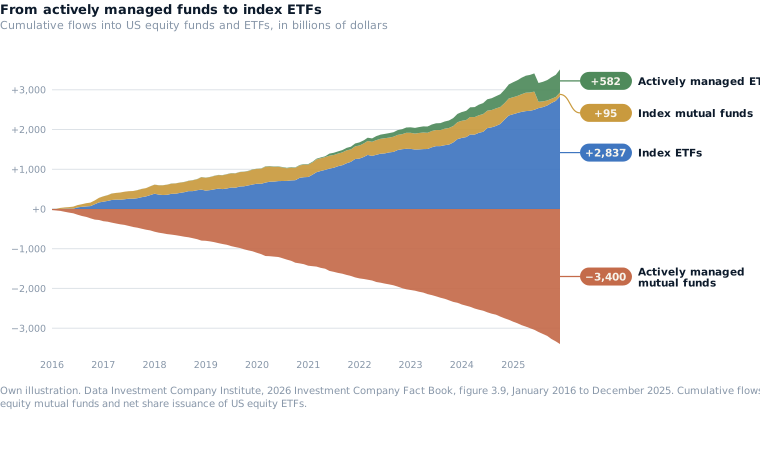
On one side sit actively managed mutual funds: a team of specialists picks what to invest in and charges a fee for that work. On the other sit index ETFs: they follow a list without anyone picking, and they charge less.
Between 2016 and 2025, roughly 3.4 trillion dollars left actively managed US equity funds. Almost the same amount flowed into equity ETFs, most of it into index ETFs.
How does an ETF work?
Most of them are index ETFs. They aim to hand you the performance of their index, minus a small fee for doing that job.
Their appeal is that they are listed on an exchange and carry a live price all day long, like a share. You know the price at the moment you place the order. A traditional mutual fund has a single price per day: you place the order without knowing it, and it is calculated after the close.
When you buy, you are immediately invested in everything inside the basket. Had you bought that first Canadian ETF, you would have owned a piece of the 35 most important shares on the Toronto exchange from that moment on.
Where do the units come from?
There is a slightly more involved mechanism behind it. When new money enters an ETF, an authorised institution buys the shares on the list and delivers them to the fund. In return the fund creates new units. When money leaves, the path runs backwards: units are cancelled and shares are sold.
None of this changes anything in your day to day. It is worth knowing for one reason: that back and forth keeps the ETF price close to the real value of its basket.
One note for anyone investing from Europe: the ETFs you find here are usually domiciled in Ireland or Luxembourg. They follow the same lists as the American ones, such as the S&P 500, but they are separate funds.
Two ways to fill the basket
- Physical: the fund buys the shares on the list. This is the most common form and the easiest to follow.
- Synthetic: the fund signs a contract with a bank, which pays it the result of the list. It works, but it depends on that bank holding up its end.
Shares or bonds
- An equity ETF has more room to grow and also larger swings in both directions. That movement is called volatility.
- A bond ETF lends money to governments or companies, which pay it back with interest. It moves less, though it can fall too, above all when interest rates rise.
Many people combine the two. The right proportion depends on you, and it is one of the first things we look at in an advisory session.
What about dividends?
The companies in the basket pay out part of their profits. With that money the ETF does one of two things:
- It passes the money to you at regular intervals. These are distributing ETFs.
- It reinvests the money for you inside the fund. These are accumulating ETFs.
Which one fits depends on your investor profile and your goals.
How do you make money with an ETF?
You earn in two ways:
- The value of the basket rises when the companies do well.
- You receive the dividends, into your account or reinvested inside the fund.
What you can expect
Nobody knows the future, and anyone who promises you a number is misleading you. History does give a reference point. The table below shows what became of 1,000 dollars, or 1,000 euros, over 22 years, from the end of 2003 to the end of 2025.
| Invested in | Per year | 1,000 became | Total |
|---|---|---|---|
| SPY, the ETF on the S&P 500 | around 10.6 % | around 9,200 dollars | +821 % |
| AGG, a US bond ETF | around 3.1 % | around 2,000 dollars | +97 % |
| Fixed-term deposit in Germany | +38 % | ||
| Savings account in Germany | +25 % | ||
| Inflation in Germany | +60 % |
That average hides a road with deep holes in it. Between the end of 2003 and the end of 2025 sit the subprime crisis, the collapse in spring 2020 and the year 2022.
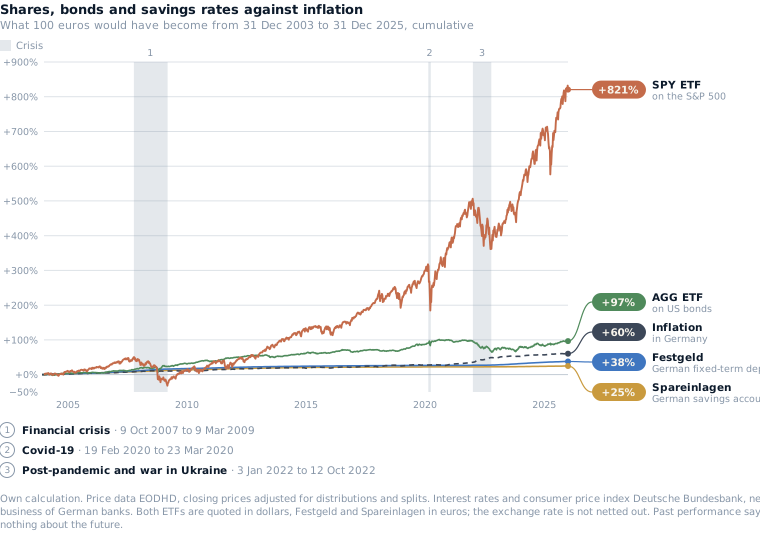
Look at the last row. Prices in Germany rose by around 60 % over those 22 years. The fixed-term deposit and the savings account grew more slowly than that. Anyone who kept their money there ended up with more euros, but those euros buy less than they used to.
That does not make them bad. For your emergency fund and for money you will need soon, they are the right place. The problem starts when they have to carry long-term goals.
Those who stayed invested through the downturn made back what they had lost in the years that followed. That is why time is your best ally. For an equity ETF, think in terms of 7 years or more.
Why you do not put every egg in one basket
A global ETF spreads your money across more than 1,000 companies in many countries. If one of them does badly, the others make up for it. This is called diversification.
ETFs on a single country or a single sector, artificial intelligence for example, concentrate your money in few names. They can rise sharply and fall just as sharply. They make sense as a small part of your investment.
The table below shows the features you can select an ETF by.
| You can choose by | For example |
|---|---|
| Asset type | Shares, bonds or other asset classes |
| Region | United States, Europe, Latin America, Asia, the whole world |
| Sector | Technology, health care, consumer goods |
| Risk level | Lower in global ones, higher in thematic ones |
Why are they everywhere right now?
If they have existed for more than 30 years, why are you running into them at every turn only now? There are four reasons.
- They cost little. A standard index ETF charges between 0.03 % and 0.30 % a year. More specialised ones reach 1 % or a little more, but that is not the norm. Many actively managed funds charge above 1 %. Over 20 years that difference pulls a serious amount out of your wealth or your pension.
- Active management struggles to beat them. The SPIVA scorecards from S&P Dow Jones Indices show that over 15 years nearly nine out of ten actively managed US equity funds trailed their index after fees.
- They are easy to use. You start with small amounts, you are diversified from day one, and you know what you hold because the fund’s list of investments is public. The fund updates itself whenever the list changes.
- Tax can work in your favour. It depends on your country and on the country where the ETF is domiciled. Germany treats this type of investment favourably. A good choice saves you money here for years.
What does it cost?
Investing in ETFs is cheap, but it has its costs. Worth knowing before you start:
- The annual fund cost. You will see it under the abbreviation TER. No invoice arrives: the fund deducts it in small slices every day from the value of your investment. The performance you see already has that cost taken out.
- Your bank’s or broker’s trading fee, which differs from house to house.
- Currency exchange, if the ETF runs in a currency other than yours.
What are the risks?
- The value falls at times. An equity ETF can lose 30 % or even 50 % in a crisis, as in 2008. That is part of the road, and it is also an opportunity to keep investing.
- Concentration. The fewer companies or countries it holds, the harder a downturn hits you.
- The exchange rate. Your ETF can rise in dollars and fall in your currency. This is called exchange rate risk, often FX risk, from foreign exchange.
- Your nerves. Selling out of fear in the middle of a downturn is the most expensive mistake, because it turns a temporary dip into a real loss. Understanding what you hold is what protects you.
That last risk sits with you and is the easiest one to shrink. A clear plan, made before the storm, helps you stay calm.
Why does the United States weigh so much?
In most indices the largest companies take up the most room in the basket. Size is measured with a multiplication: market value equals number of shares times price per share.
Many of the largest companies in the world are American, which is why they occupy so much space in global ETFs.
Are they always worth it?
There is a lot going for ETFs. Picking from thousands of them is work, though.
Two ETFs tracking the same list of companies can differ in cost, size and tax treatment. On top of that come the real questions: how much risk, over what period, with what amount, and when to rebalance. Comparing all of that takes time when you are just starting out.
They are also not the only option. An actively managed fund can serve you well if you are after a narrower market. If you are considering one, compare its performance after fees with that of a similar index ETF.
Frequently asked questions
What is the difference between an ETF and a mutual fund?
An ETF is listed on an exchange and carries a price all day, while a traditional mutual fund is priced once a day after the close. Most ETFs also follow a public list, whereas in an actively managed fund a team selects the holdings and charges a higher fee for it.
How much money do I need to start?
Small amounts are enough to begin, because you buy a share of the basket rather than each company separately. More important than the size of your first amount is investing regularly and being able to leave the money alone for years.
How long should I hold an equity ETF?
Think in terms of 7 years or more. Over that span, historical downturns have had the chance to recover. Money you need before then does not belong in an equity ETF.
Distributing or accumulating, which is better?
It depends on whether you want regular payouts or want to build wealth. An accumulating ETF reinvests the dividends without you doing anything, a distributing one pays them out. Germany taxes both variants, so let your goal decide.
Can an ETF go bust?
The fund’s assets are held separately and do not belong to the fund company. If the company fails, your share of the basket remains. You still carry the market risk of the companies inside it, of course.
Your next step
You now know the essentials. What remains is how much you invest, in which ETFs, in what mix, and how to set it up sensibly for tax.
In an advisory session we look at your goals, your investor profile and your budget, and we build a plan that fits your situation. A portfolio check is where it starts.
This article is for information and is not investment advice. The value of investments can rise and fall, and past results do not guarantee future results.
Sources
- Flows into US funds and ETFs, January 2016 to December 2025 · Investment Company Institute, Fact Book
- Share of actively managed funds trailing their index over 15 years after fees · S&P Dow Jones Indices, SPIVA
- Returns on fixed-term deposits and savings accounts in Germany · Deutsche Bundesbank, interest rate statistics
- Price development in Germany · Federal Statistical Office, consumer price index
- Performance of SPY and AGG, 31 December 2003 to 31 December 2025, in dollars · State Street, BlackRock iShares
Wenn du deine eigene Situation in Ruhe besprechen willst: wir melden uns bei dir.